The Magic of Collaboration
“One Who Knows Me” 知我者
This little post is inspired by a conversation I had with my daughter and her sweetie last night during a sunset beach walk, where we explored different models for teaching (or perhaps “guiding” would be a better term) workshops on Zoom. So it got me thinking about where I am at in my teaching, why I do what I do, and how I might share the insights I have gained along the way with you all….(the title is also inspired by the lovely title of a book on Tang poetry written by my old friend Anna Shields)

I have been trained in the traditional academic way, through countless sink-or-swim situations over the decades, necessitated by the financial pressures of being a struggling musician, farmer, foreign student-researcher, and philosopher. My teaching career started in earnest as a “teaching assistant” for a huge East Asian History and Culture course that was a basic 100-level required humanities class with well over a hundred students each semester at the University of Arizona. Because the professor was old, exhausted, ready to retire, and possibly impressed by my thick German accent, I ended up somehow teaching even some of the big lectures in addition to the discussion sessions, thrust in front of a microphone when I was barely out of high school myself! Spending my college vacations as a hard-working and pretty obnoxious street musician in East Asia didn’t hurt either. Luckily I was too small of a fish to fry for the Yakuza (Japanese mafia) patrolling Ginza to keep the riffraff out of Tokyo’s fanciest area, and got off easy with just a warning. So I have learned to perform my teaching duties in an endless variety of social environments, cultural contexts, group sizes, age groups, and topics, with kindergarten mudpits definitely more fun than stuffy academic conferences.
Covid changed the nature of teaching by moving so much of it online. In so many ways, this has been a big blow for the style of teaching I thrive in, which is primarily interactive, participatory, playful, and experiential. Many fellow teachers agree with me that teaching on Zoom is exhausting and draining while teaching in person, when it flows, is inspiring, fun, and heart-filling for every participant. A very different beast! Whether we like it or not, whether all the benefits of greater accessibility across time and space outweigh the challenges or not, for better or for worse, it is here to stay and has allowed me to run a little solo homestead complete with milking goats and a serious garden and truly become a part of my local community, as I would never be able to if I had to regularly travel the world for work like I used to do pre-Covid. My dog and cat are grateful…
In response to this unavoidable new reality and to replicate the interactive and engaging nature of in-person classes, I have embraced any opportunity I get for what is usually called “team-teaching.” But what does that mean, what does it look like, what does it require, and what are its pitfalls and benefits? On the simplest level, it involves two teachers agreeing to a clearly defined curriculum of material that needs to be “taught” to the students, and then to split this information up into distinct sections handled by each teacher separately. One example of this would be a class on Chinese Gynecology that I was hired to team-teach at the National University of Natural Medicine a long time ago in collaboration with Dr. Guangying Zhou, a highly experienced clinical practitioner. I was in charge of the first half of the semester, where I introduced students to the gynecological content in the classics (Neijing and Shanghanlun and Jingui) and the historical roots up to and including the Song dynasty, and then Dr. Zhou taught the second half on clinical content in contemporary application. It was an abrupt change for the students in the middle of the term, but they did get to benefit from the expertise of two teachers that neither would have been able to teach such a complex course on their own with the same level of expertise and insight. In that case, the framework was clearly established by the administration, and it was easy to slip into my assigned role of just teaching for half a semester. This is the standard model for team-teaching, one that most teachers are comfortable with and able to fit into, two people simply taking turns delivering information to a passive audience, and there is nothing wrong with it. it’s a quick and easy way to split up a topic that requires more specialized knowledge than a single person might possess. And it’s great for students to get exposed to two different perspectives in this way. I have had plenty of this kind of collaborative experiences with colleagues at conferences or retreats. BUT… they tend to leave me dissatisfied, aware of a missed opportunity, because the sum of two people’s expertise is so much more than simply adding one to the other. They have tended to come as a surprise for me because I thrive in the midst of dialogue and even disagreements and am always eager for professional exchanges. What better opportunity than a class taught on a shared topic with a fellow teacher who comes at it from a different background!
As all my students will tell you, I get super excited when somebody pushes back and states an opinion or fact that contradicts something I said or wrote. That’s where the fun starts, where the learning begins for all of us, where the creative juices flow and the magic happens! Sometimes, with certain people and in high-stakes academic contexts that promote a domination-based idea of conflict that can only result in one person being right and the other being wrong, these disagreements take on a confrontational emotional intensity that I experience as being the opposite of conducive to learning, whether my own or that of the collective. When we are forced into a situation where it becomes more important to be right than to increase our understanding, the fun stops and it’s time for me to leave the space. So I have learned to avoid these kinds of people and contexts, whether in Facebook groups, on Zoom, or in conferences.
Ideally and increasingly more over the years, I have learned to grow from such conflicts, to meet it not with defensiveness but with curiosity, and to actively cultivate an awareness of this challenge, to try and create or support the container for both myself and my conversation partner/s to step back and listen to each other and “agree to disagree.” Some people respond to that invitation positively and meet me half-way, and some don’t. And, truth be told, sometimes I am more successful at remaining in that space of curiosity and respect than at other times. Most of us are not sages who can maintain perfect equilibrium all the time, no matter what the external environment throws at us.
Here are three other examples of team-teaching that have been formative for me:
For two precious years, I got to team-teach a course on the Neijing with Dr. Long Rihui at the National University of Natural Medicine. In this case, there was a clear hierarchy of Dr. Long being one of the most beloved senior faculty members at the College of Classical Chinese Medicine, adored by students and fellow faculty alike, with a deep rich long lifetime of clinical and teaching experience that he had been sharing with generations of patients and students from an ocean of wisdom and compassion. He really wanted to retire, but somehow we coaxed him into sticking around for a couple more years by me doing the paperwork, preparing all the handouts, handling grades and schedules and syllabi, and always being on standby to teach when he didn’t feel up for it. He knew he could just walk into the classroom, and the students and I would simply be grateful for his presence, supplemented by marvels of wisdom, long strings of classical quotations scribbled in lightning speed at the blackboard in Chinese, and juicy case studies from his own experience. It was hard at times to contain his enthusiasm and to slow him down just enough that I’d be able to translate and explain things to the students. These were not easy classes for the students or for me, but we all knew how very lucky we were to be present for this interaction. I learned more about the Neijing in those two years than in decades of reading dead commentaries and gladly took on all the unpleasant administrative tasks of running the class in exchange for the gift of Dr. Long’s teachings.
For years, I got to teach courses and lectures on pregnancy and postpartum care with my dear dear friend Debra Betts from New Zealand. We are very close friends and deeply respect each other’s training and background (and love getting together). While coming at this topic from completely opposite directions, Debra being a former NICU nurse and very knowledgeable in the latest scientific findings and me being a crusty historian and medical anthropologist, we shared such a strong love for the topic and each other that we were able to pull it off. We’d make plans how to split the teaching up but then frequently jumped in when the other person would say something exciting or surprising, with questions or comments that delighted and informed all participants. It always felt like the room was alive with joy and love and curiosity, but also solidly grounded in experience and factual information. Two professional friends and colleagues, tag-teaming it with deep respect for and interest in the other person’s world. Covid put a stop to this fertile collaboration because it ended the in-person conferences where we were able to meet up and have fun together.
Last, but most definitely not least, for the past few years I have been teaching with (and learning from) Leo Lok. Our friendship and collaboration has grown gradually over the years: from our disembodied interactions on the Scholars of Chinese Medicine Facebook page a decade ago; to his help in answering brief translation questions and eventually proofreading whole book manuscripts for me; to his increasing involvement in my Pebble in the Cosmic Pond podcast and my Imperial Tutor mentorship; to first one and then more and longer team-taught courses on line; to almost daily Zoom calls that often last several hours and meander all over the place; to teaching a deeply personal course on cultivation that triggered deep personal transformation in both of us; to Leo actually becoming something of a spiritual advisor to me in his knowledge about Buddhism as a tool for handling some intense personal conflict situations in my life these past few years; to actually meeting up in person in Vietnam a few months ago and, to our relief, discovering a shared appreciation for the amazing food, architecture, and, most importantly for me, kindness and quick sincere smiles of the Vietnamese people… We have grown to know and love and respect each other, to the point where we both care so deeply about each other that the other person’s wellbeing always matters more than a business task, no matter how urgent that may appear. We both know that, in a pinch, one of us can carry the load on their own for a while, and have thus been able to give each other necessary space in times of trouble. And yet, we both keep showing up for our shared courses, no matter what was happening outside that studio door five minutes before we hit the “record” button. And our recording sessions never get boring (at least to us) because we have an unsurmountable mountain of unanswerable questions, texts to discover, passages to take apart, authors and practitioners and philosophers to get to know, and yes, nuances of meaning and perspective to disagree on. Given our personal differences, the evolution of our work together has not been easy by any means, but what has allowed us to always come back together and grow from each instance of friction is our shared love for the work and the conviction that together, we are stronger, wiser, more productive, and more effective than each of us could ever be on our own. I am keenly aware of how fortunate I am to have found a true business and teaching partner who I can banter and playfully explore with, disagree with, even get grouchy or rude with, who I can share my vulnerabilities with, who I can truly depend on and share my life’s work with, who is my intellectual and professional equal, in this lifetime. And I hope that Leo feels the same way. AND I do believe the strength of our collaboration does show in our work together.
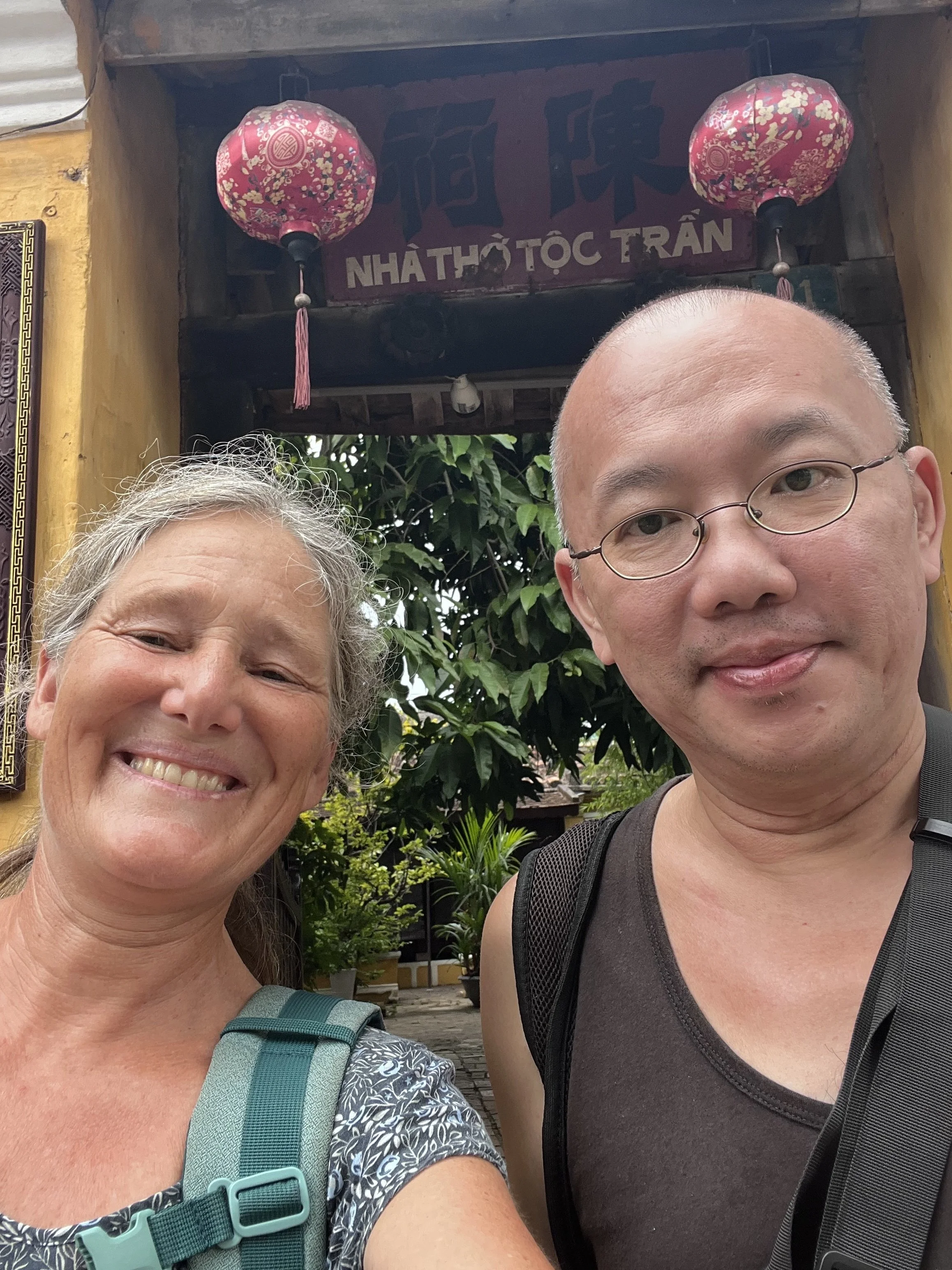
Leo and Sabine in Hoi An…
My intention for sharing all this personal information with you all in a public blog is that I want to spell it out and let you see that this sort of a business relationship is possible, even in what sometimes appears like a cruel world of cut-throat capitalism and competition. It takes a whole lot of time and energy, of dedication and emotional maturity, of courage and trust and intellectual humility… and of course you have to be lucky enough to find your own “Leo” who is able to complement the weird constellations of personality traits and life experiences that hide under the wrinkly old bag of bones called “Sabine”….
Do you have a positive experience with collaboration that you can share in a comment below? What do you see as some of the greatest challenges and benefits? How do you benefit and what have you learned from the complementarity in your professional and personal relationships?
Thanks for reading…. and if you are curious about our courses, check out the upcoming course on “Nurturing Our Nature” that starts September 19 or have a look at our Courses page here: