Yangsheng Pearls from the Ming Period
(A guest blog by Tom Ehrman)
Introduction by Sabine: I am grateful that Tom Ehrman once again has generously allowed me to share his work with you all in this format. It feels so relevant to where I am at right now, and also to the course on Yangxing “Nurturing our Nature” that Leo Lok and I are just starting to teach. The photo at the bottom depicts my dog yesterday hanging out with me for perhaps our last beach tea session of the year, before cold weather puts an end to one of my favorite personal yangsheng practices.
To briefly introduce this piece, it is a selection from a short book full of casual notes on yangsheng by Chen Jiru (1558–1639 CE), a famous painter, calligrapher, and author of the late Ming dynasty. The selections come from a text called Yǎngshēng Fūyǔ (Casual Remarks on Nourishing Life). Here are some excerpts, translated by Tom Ehrman:
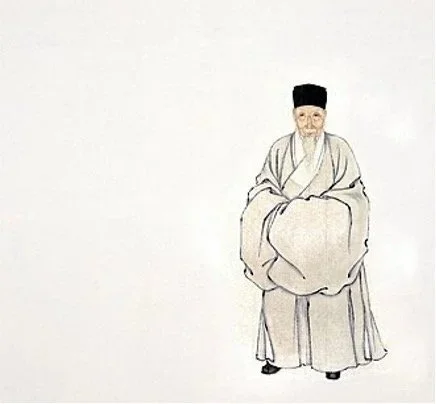
(Qing dynasty, Xu Zhang —Chen Jiru (1558–1639) from ‘Portrait Album of Notable Figures of Songjiang’, preserved in the Nanjing Museum, PRC
Translation:
《养生肤语》
Casual Remarks on Nourishing Life
Heaven and Earth bring forth human beings through Qi; therefore, humans cannot for a single day or a single moment exist apart from Qi. Just as with fish in the water, their gills constantly opening and closing without pause, so with human beings in the cosmos, the breath ceaselessly passing in and out through their nostrils. It is this Qi, which governs nature, upon which human beings rely for life. Thus it is said: “When one eats according to the proper season, the whole body is in harmony. When one acts at the proper time, everything is done peacefully.”
Consider this, when human life is subject to frantic activity and exhaustion, the Qi begins to run wild. When the Qi runs wild, more leaves than enters; what is outside cannot come in, and what is inside becomes ever more depleted. Thus, the time of death draws near. It is only the sage who observes the natural laws, adheres to the seasons, holds the spirit in stillness, and directs every breath back to the navel (dāntián), who thus attains the longevity of Heaven and Earth. Therefore, be aware that while a person lives in this world, that which is visible is their physical form; yet that which enables them to endure and live long is their Qi.
Guo Kangbo met a holy man who imparted to him a method for preserving the body and maintaining health, saying: "There is a verse of just four lines, to which you should hold fast wherever you are." The verse says: “When the body is ill, the heart itself knows it; to restore a sick body, one must rely on the heart to heal itself. When the mind is tranquil, the body is at peace; when thoughts circulate in the mind, illness is born.” Guo trusted this advice and knew how to look after himself, enjoying unusual health and vigour. He lived to nearly a hundred years of age. All of this is brought about by properly nourishing the original Qi. The Qi of Heaven is ever clear, the light of Heaven is ever bright. With nothing to cause it any hindrance, it thus endures long. What people see as clouds and mists, swiftly appearing as if by magic and then vanishing, are all in a realm close to the earth. A hundred lǐ above this realm, there are none. When the human body is constantly disturbed by the seven emotions and six desires, or harassed by the three poisons and six harms, how could it possibly endure long? Yet if one can truly become as pure and luminous as Heaven and Earth, how could one fail to share Heaven and Earth’s imperishable nature? Qīngtiāngē (Song of the Blue Sky) says: "Out of a blue sky, floating clouds suddenly arise, spreading far and wide and concealing everything as though with a veil." Those who nourish life must discern this well.
…
Wèishēnggē (Song of Preserving Life)1 says: "Only when wood is kept away from fire does it not turn to ash; only when a person can remove fire do they prolong life." How true these words are! When a person exhibits anger, envy, grief and passion, or becomes agitated, rushing around, leaping, dancing, singing, or howling—all such excitement stemming from interactions between oneself and others—which of these is not brought about by fire? Wood rubs against wood, and through friction fire is produced; people interact with one another and desire is generated. The principle is exactly the same. If a person can understand this principle and exercise restraint in every matter—subduing their anger and moderating their desires—then the five Qi will naturally reach balance, the six pulses will naturally achieve harmony, and longevity will surely follow.
…
In human life, food and drink require the utmost care, as it is through them that the Qi within our body ascends, descends, gathers, and disperses. Why is this so? Drinking too much wine causes Qi to ascend; drinking too much tea causes Qi to descend; eating too much meat and grain causes Qi to stagnate; eating too much pungent food causes Qi to scatter; eating too much salty food causes Qi to sink; eating too much sweet food causes Qi to accumulate; eating too much sour food causes Qi to bind; eating too much bitter food causes Qi to be repressed. Masters who cultivate the Tao therefore regulate the five internal organs (zàng) and keep their mind and spirit flowing freely, relying entirely on carefully measuring the five flavours and restricting their food and drink, ensuring they do not overindulge—only that will suffice.
Among the methods for keeping illness at bay, there is the practice of Qigong. For deficiency illnesses, one must practice nèigōng (internal exercises) of visualisation and concentration, to consolidate and preserve the body and so supplement it. For excess diseases, massage and dǎoyǐn (guiding and stretching) are suitable, as well as special breathing exercises, using external techniques to scatter and disperse them. For illnesses of heat, one should exhale the old and inhale the new, exhaling through the mouth and inhaling through the nose to cool the body; for illnesses of cold, one should retain the Qi and hold the breath, with the intention of generating fire to warm the body. These four methods can serve as a shortcut for curing illness, far surpassing the taking of herbal or mineral medicines. I learnt this from the words of an old practitioner of the occult arts.
…
Lu Yuanhe, in discussing the essentials of nourishing life, said: "It is nothing more than concealing the spirit in the deep abyss, and preventing it from wandering outside. Over time, spiritual transformation will occur quite naturally." Let us say no more; I have full confidence in these words of his. The spirit is such that it can be neither known nor recognised by the intellect. If retained over time deep inside the body, it shines ever more brightly within. Then essence and Qi return to their true state, and spiritual transformation occurs naturally. An ancient immortal said: "Qi is the medicine that adds years to life, while the heart-mind is the courier of Qi and spirit (shén)”. If one can make spirit and Qi abide, that is to become an immortal. As for what is called "spirit and qi abiding", does this not refer simply to keeping the spirit within? The world generally calls immortals ‘shénxiān’ (spiritual immortals) because what they refine is the spirit.
…
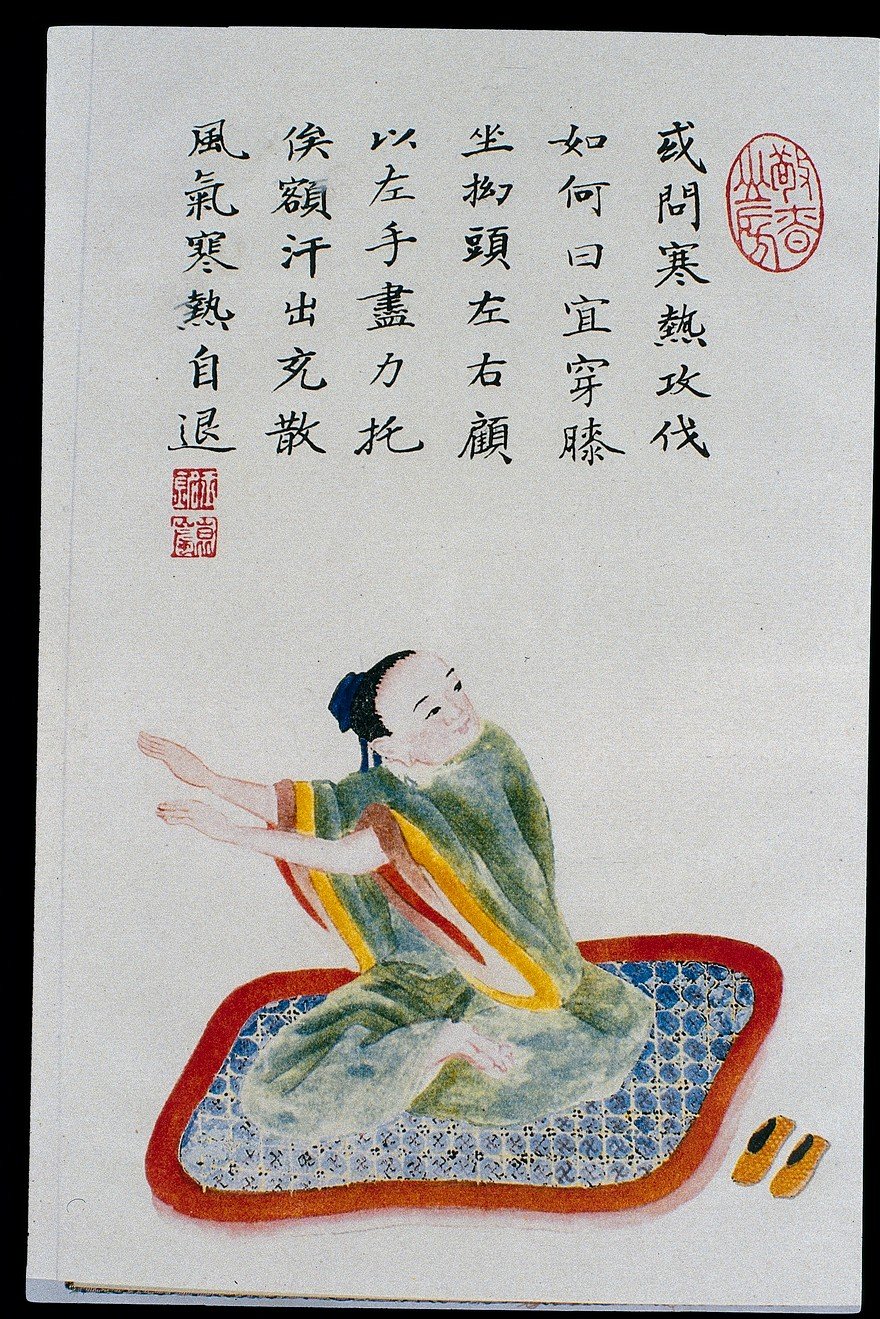
There’s a common saying that a robust and vigorous person possesses ‘Qìlì’ (Qi and strength). This shows that strength and Qi are inherently interconnected, and strength derives from Qi. Any activity such as shouting, leaping, singing or whistling, wild dancing, rushing around, or anything that involves strenuous effort can diminish Qi. In ancient times, those skilled in nourishing life exhaled without making a sound and walked without raising dust. They did not dance constantly, but practiced movements such as ‘swaying like a bear’ or ‘stretching like a bird’; they did not spend their time whistling, but practised breathing exercises to cultivate their primordial spirit (yuánshén). It is almost as if they desisted from ‘strength’ in order to generate ‘Qi’.
…
[They say that] a well does not overflow if water is not drawn from it, and essence (jīng) does not become excessive if it is not used. Why is this? Water comes from within the earth, and drawing it out causes more to come; essence fills the body, and expending it causes it to be replenished. Yet neither overflows or becomes excessive on its own. However, people misunderstand this idea. They may say that drawing from a well causes no apparent decrease, but they do not appreciate that drawing too frequently exhausts the earth that is its source; they may say that using essence shows no apparent loss, but they do not realise that frequent use exhausts the true origin (zhēnyuán). Therefore, those who understand the principle of drawing from a well, take good care of the well, so that it is never exhausted; those who understand the way of using essence, do so in an intelligent fashion, so that it is never depleted.
…
Daily nourishment relies entirely on the five flavours. If they are excessive or unbalanced, the five internal organs (zàng) will become lopsided. Not only does one fail to receive nourishment, but it may even damage one's life. Examine a food’s true flavour; things like the five grains, beans, wheat, even melons and fruits, all have a predominantly bland flavour. From this one can deduce the original intention of Heaven and Earth in its nourishment of mankind. Supreme flavour is to be found within blandness. Nowadays, people strive after strong, heavy flavours—have they not almost lost the true nature of flavour? When the ancients said "few are those who can understand flavour," it was precisely because most people do not know that flavour's true essence is blandness.
Zhou Liuguan of Kunshan was a refined scholar in every respect. I previously had the honour of meeting him; he was skilled in poetry and good at painting, and his execution of Zhao-style calligraphy1 was also remarkably lifelike. Furthermore, he loved entertaining guests, collecting antiques, patronizing singers and musicians, and playing stringed instruments. Yet I thought privately to myself: “With this gentleman's essence and spirit (jīngshén) spread so thin, and so many different hobbies, how can he hold out for long?” The following year, Mr. Zhou did indeed pass away. From this we can see that, in life, one’s pleasures should be naturally focused and directed. If one has too many passions and too many skills, it will instead wear out one’s spirit and damage one’s essence. Is this perhaps governed by the same underlying mechanism as someone who eats too little but does too much?
…
Ma Jiantian was skilled at discussing deep metaphysical principles and, at sixty-five years of age, his hair and whiskers were still completely black. Li Shaobai was not remotely skilled at discussing deep metaphysical principles, yet at the age of seventy, his hair and whiskers were also black, and he retained a youthful countenance. I once asked Jiantian about his art of nourishing life, and he said: 'I do not eat salty food, I do not drink tea, and I make the preservation and nourishment of essence, Qi, and spirit my primary concern. Every day I sit by myself in my room, with nothing to occupy me.' When I enquired the same thing of Shaobai, he said nothing at all, but every day he grinned cheerfully, paying no heed to worldly matters. Even in the midst of trials and tribulations, he showed no signs of grief or worry—yet he never severed his connection to the bustling life of the city. If that is so, did these two gentlemen attain longevity through acting in the same fashion? Or rather, did they behave quite differently on the outside, while being internally the same?
…
The secret formulas for internal cultivation, if one has not truly and profoundly grasped them, must not be experimented with lightly. Frequently there are those who bring disaster upon themselves because of it. I once saw a disciple of Xie Binshan practice the formula of inner visualization; he stirred up internal fire too urgently, and before long he suffered from dysentery of the ‘five colours’ and died. There was a friend from Suzhou who learned the art of breath retention from a foreigner at a certain pagoda; after only six months, he likewise fell ill with dysentery and collapsed. A certain scholar-official, upon hearing that a former classmate had developed an abscess and perished, remarked: “This person must have practiced meditation in the past.” Upon enquiry, this turned out to be true. From this we know that when the method encountered is not genuine, striving to benefit only leads to harm. Just look at the mundane art of refining gold and silver: if the timing and intensity of the fire are even slightly off, the cauldron and furnace are lost along with it. How much more so with the human body, which cannot be compared to a physical cauldron and furnace! Let those inexperienced practitioners, who try their hand at this, be extremely cautious and not rely blindly on half-baked methods. How true this is!